Studying what wins on Meta now
Before you build anything, you need a working picture of what a winning direct-response ad does that a losing one doesn't. This is your reference photo. Pin it somewhere. Post-Andromeda edition.
Studying what wins on Meta now
~2,200 words · the weak-vs-strong tables, the T-E-E-P framework, and Meta's own diversity cheat sheet
This guide covers the "Three Realities" and T-E-E-P frameworks, Meta's own creative-diversification guidance, and Seed Health's "pooping every day" pillar as a live example of creative diversity.
Weak Ads Vs. Strong Ads, Side By Side
Sarah Levinger's central argument: most "direct response" ads fail not because the offer is bad or the design is ugly, but because they're built from the wrong starting point. Weak ads start from a clever hook, a competitor swipe, or a generic persona. Strong ads start from a specific moment in a specific customer's life, what Sarah calls a micro moment.
| Weak DR ad | Strong DR ad | Why it works |
|---|---|---|
| "She wants to lose weight." | "She avoids being in photos at her friend's wedding because she hates how her outfit fits." | Specific situation, social pressure, emotional stakes. |
| "He wants a better wedding ring." | "He keeps taking off his wedding band because it's uncomfortable, then misplaces it." | Names the behavior behind the demand. |
| "People want nice art." | "I moved into a new place, but the empty walls still make it feel temporary." | Turns home decor into identity and belonging. |
| Build from a clever hook or a competitor swipe. | Start from the customer moment, the brand goal, and the buyer's psychological state. | The ad is pointed at a real buying condition, not a vibes-based guess. |
| "Self-care starts at home." | "It's 11pm and you're still answering Slack messages in bed." | The category cliché vs. the actual moment the customer recognizes the problem. |
| Hard-sell someone who hasn't realized they have the problem yet. | Show them the moment that names the problem. Save the sell for later. | You can't close a sale that hasn't been opened. |
| Send a ready-to-buy customer into more education. | When the customer has a credit card in hand, make the offer clear and let them buy. | Extra explanation past purchase intent creates friction, not trust. |
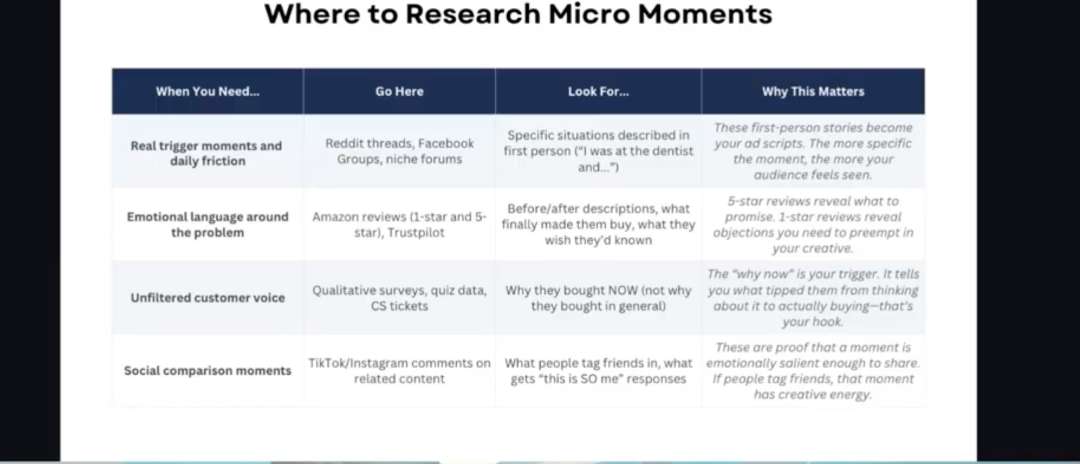
Sarah's Three Realities: The Layered Research That Produces Strong Ads
Sarah's three-reality framework is the system behind those strong examples. Every good DR ad is the intersection of three things:
| Reality | What you're researching | The question it answers |
|---|---|---|
| Customer Reality | Generational context, micro moments, emotional state. Pulled from reviews, Reddit, Facebook groups, support tickets, post-purchase surveys. | What is actually happening in this person's life, mind, language, and emotions right now? |
| Brand Reality | Brand health (cost per acquisition, conversion rate, marketing efficiency ratio), operational capacity, internal alignment, what the team can produce at quality. | What does the business need creative to do this month, and what can we credibly deliver? |
| Presentation Reality | Which format and structure match the buyer's psychological state (see T-E-E-P below). | How ready is this person to buy, and what format meets them there? |
Customer Reality alone produces ads that resonate but miss the business goal. Brand Reality alone produces ads that hit the goal but feel hollow. Presentation Reality alone produces format-of-the-week ads that win attention and lose the sale. You need all three to align.
The T-E-E-P Framework: Matching Format To Buyer State
The same persona, with the same pain point, needs different ads depending on where they are psychologically. A trigger-stage buyer who's just become aware of the problem needs a relatable scene. A purchase-stage buyer with a credit card out needs the offer clearly stated and the friction removed. Use the wrong format for the stage and you waste the impression.
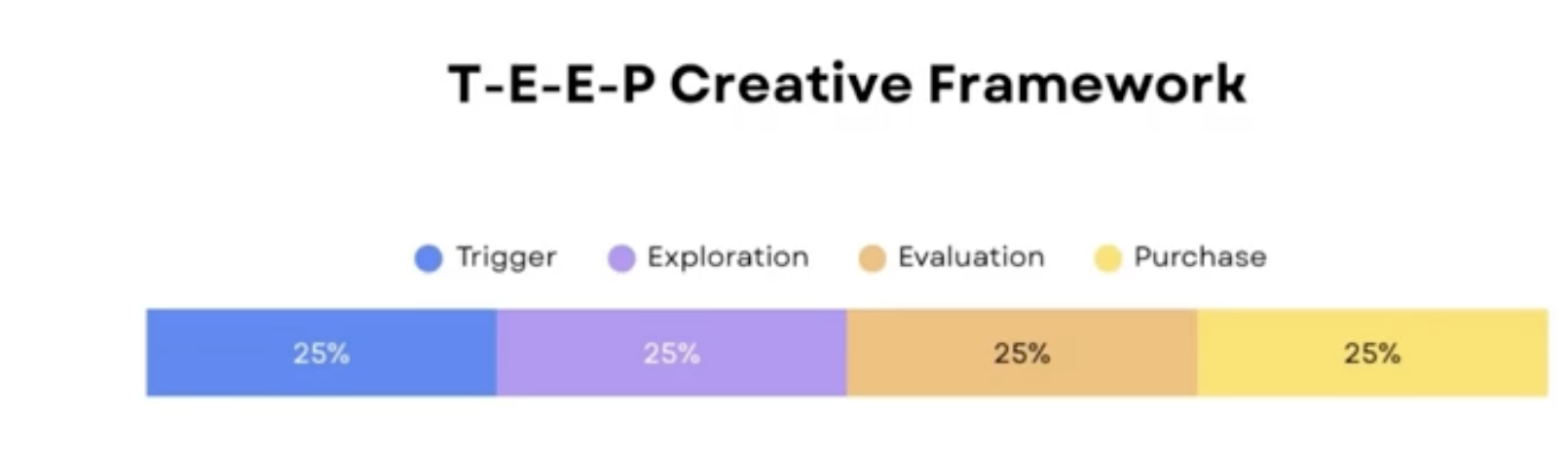
| Stage | Buyer state | Format match | Creative job |
|---|---|---|---|
| Trigger | Pre-awareness; life is happening, problem isn't yet salient. | Micro-moment scenes, relatable hooks, "this is so me" content. | Name the moment the buyer is already living. |
| Exploration | Low commitment, high novelty, scrolling and curious. | Short-form video, visual hooks, memes, pattern interrupts. | Earn attention without over-explaining. |
| Evaluation | Medium commitment, considering options, needs proof. | Testimonials, before/afters, education, case studies, us-vs-them. | Build credibility and help them compare options. |
| Purchase | High commitment, ready to buy, last objections live. | Long-form, objection handling, guarantees, founder stories, demos. | Remove final friction and answer remaining questions. |
Sarah credits Google here: Exploration and Evaluation are Google's "messy middle", with Trigger before and Purchase after.
Creative Diversity: What Andromeda Actually Rewards
Once you have a winning concept, the next mistake to avoid is making nine variations that all look the same. Andromeda matches buyers to creative based on signals it pulls directly from the ad, so it needs different signals (visual, message, format, hook) to identify and reach different sub-segments of your audience. If your nine ads all use the same template with different headlines, you've given the algorithm one shot at finding buyers instead of nine.
Dara Denney's 5 Levels of Creative Diversity goes deeper here: real diversity comes from targeting different journey stages and uncovering new personas, not just swapping formats.
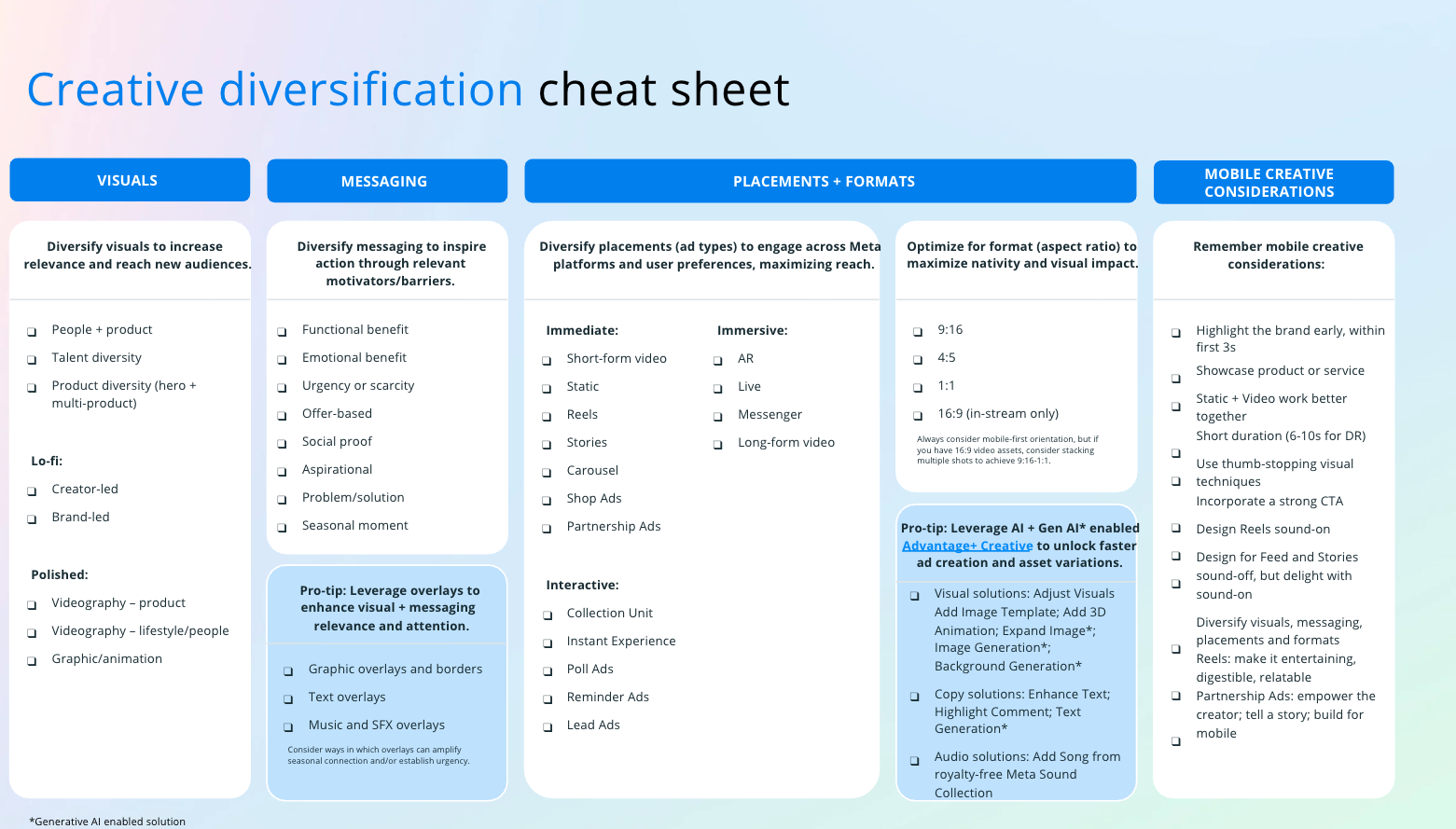
Meta publishes an official Creative Diversification Cheat Sheet, downloadable directly from Meta, covering five axes to vary across your account: Visuals (people vs product, talent diversity, light vs polished), Messaging (functional benefit, emotional benefit, transformation, social proof, education), Placements and Formats (Reels, Feed, Stories, vertical/square ratios, carousels), Audiences (immediate, broader, saturated), and Mobile Considerations (vertical-first, safe zones, sound off). One tip from the sheet: use AI to generate diverse variations from a single winning concept.
Seed Health: One Concept, Nine Wrappers
Dara Denney's favorite live example, and the cleanest demonstration of this principle. Seed Health identified "I'm finally pooping every single day" as a creative strategy pillar that resonates with their core persona. According to Dara's public teardown of their Meta Ad Library, roughly 1 in 7 of their ads features this exact angle.
But look at what they do with it:
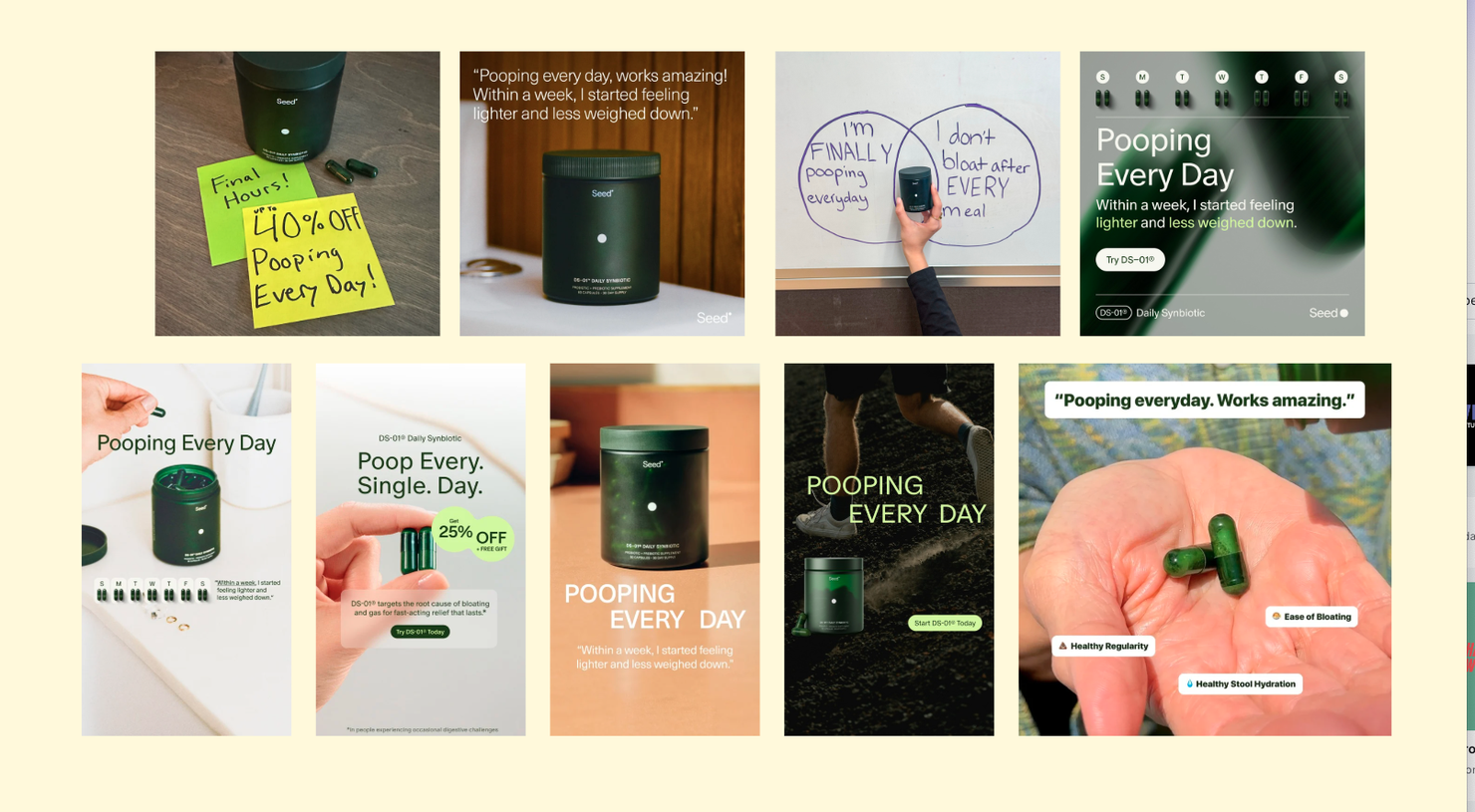
Nine Seed Health ads. Same core angle, nine different wrappers: a handwriting-style headline, a jar product hero shot, a UGC review screenshot, a journal-style copy block, a percentage-off promo, a product comparison, a customer-hand product shot, a multi-tier vertical, a two-up split. Each one targets a different sub-segment of the same persona, with the same underlying claim.
Putting This To Work
Before you move to production, run every concept through this quick three-check filter:
- Is there a specific micro moment? Could you describe the customer's situation in one sentence with a scene, an emotion, and a "why now"? If not, go back to reviews.
- What T-E-E-P stage is this ad for? Trigger, exploration, evaluation, or purchase? If you can't tell, the ad is doing too many jobs at once.
- How does this vary from my other ads? Across the Meta diversity axes (visuals, messaging, format, audience signal), what makes this one different? If it's only a headline swap, that's a 1-axis variation, not a real diversity play.
Concepts that survive this filter go into the production pipeline next.
Sources and credits. The Three Realities + T-E-E-P frameworks in this guide are taught publicly by Sarah Levinger, including this video. The Seed Health teardown and the "one concept, nine wrappers" framing come from Dara Denney, Partner at Point Guard Media. Both publish openly across YouTube, LinkedIn, and their own newsletters; go follow them, that's where the real-time updates live. We're crediting them for teaching and refining these frameworks, not necessarily for inventing every component (Sarah credits T-E-E-P's shape to Google's "messy middle", whose Exploration and Evaluation loops sit between Trigger and Purchase). The Creative Diversification Cheat Sheet is Meta's, published directly by them. The synthesis into one operating system is ours. If the frameworks land, that's because of Sarah and Dara. If anything is wrong, that's on us.